

The Pre-Intake Problem: When Injured People Are Searching for Answers, Personal Injury Attorneys Are Missing From The Conversation
What happens to an injured person before they call an attorney?


Dear Personal Injury Attorney,
Maria got injured on a Tuesday morning when another driver ran a red light.
The collision wasn’t her fault (the police report says as much), but fault doesn’t pay her chiropractor or cover the four days of work she’s already missed. Fault doesn’t tell her whether to talk to the insurance adjuster who keeps calling. It doesn’t say what to do about the medical bills that are starting to arrive before she’s even had time to understand what happens next.
Her neck hurts. Her husband is worried. She has two kids, a job that requires her physical presence, and zero experience navigating the aftershocks of an injury.
So, she does what most people who’ve been injured do—she waits.
She handles what she can, tries to learn about what she doesn’t understand, and does her best to manage her pain day by day.
Weeks pass, and the bills accumulate. A friend mentions that a personal injury attorney might be able to help. They typically don’t charge anything up front, and she might be entitled to more than she realizes. Maria is curious. So she opens ChatGPT and starts asking questions to understand her situation.
What should she do about the insurance adjuster who keeps calling?
Is the settlement offer she already received reasonable?
Is her case even worth calling an attorney?
The answers she gets are detailed, confident, and, in some ways, genuinely useful.
But they’re also missing fundamental information.
The AI that walks Maria through her options has no stake in her outcome. It doesn’t know the specifics of her injuries well enough to flag what she might be undervaluing. It can’t represent her, negotiate on her behalf, or sit across from an insurance company and make the case that her life has been meaningfully disrupted. And it may not tell her what an attorney would in the first five minutes of a free consultation—that the offer on the table is a tactic designed to close her claim before she understands what it’s worth, and that anything she says to the insurance company can and will be used against her.
By the time Maria finally thinks about calling a personal injury attorney, she’s formed opinions about what she needs and what her case is worth.
Some of those opinions are grounded in credible information. Some are not. And the attorney who eventually takes her call is now working with a client who has spent weeks being educated by an AI tool that has no legal duty of loyalty, confidentiality, or competence to Maria. AI is not a lawyer.
Maria’s story is not unusual, or even close to the worst version of a personal injury case. It’s a moderately serious accident, with an increasingly overwhelmed person, within an extremely confusing system.
The details change from case to case, but the dynamic doesn’t. Someone gets hurt and needs help, but they don’t know where to find it. They get overloaded with content the moment they look online. And they don’t know how to tell the difference between false information and fact or how to make use of any of it.
If you’re a mission-driven personal injury attorney, you went to law school because of people like Maria.
You didn’t go for the contingency fees or competitive appeal of a $57 billion market.
You became an attorney because someone you love got hurt once. Or you saw what happened when people without resources tried to navigate a system designed for people with resources. Or you simply believe the injured deserve someone in their corner who knows what they’re doing.
If you’re that attorney, you’ve spent years building a reputation.
You have wins on cases that mattered. You have relationships with clients who trust you. You have a community presence. You have a body of work that any human being who talked to you for five minutes would immediately understand.
When a client like Maria never calls you, it’s because she doesn’t know you exist.
The gap between a personal injury attorney who serves people and an injured person who never finds one is what this mini-book is about.
Our team at LawSHIFT has spent decades working inside the personal injury market and legal tech space. We’ve watched the mechanics of how PI firms grow, stall, and chase the next thing that promises to change the math. We’ve seen firms invest heavily and intelligently into every platform that mattered at the time (Yellow Pages, TV, radio, billboards, Google, social media, etc.) and build credible positions as a result. And we’ve watched those positions erode as the platforms shifted and new competitors arrived. The economics of getting found kept climbing while the number of inquiries that turned into consultations stayed stubbornly, mystifyingly low.
What shaped our thinking was a question nobody seems to ask:
What happens to an injured person before they call an attorney?
What happens before they open ChatGPT or Google? Before they decide they need an attorney? In the hours and days and sometimes weeks when they’re hurt and confused and carrying the weight of something they don’t have the language or framework to navigate?
What’s happening to them, and who’s showing up for them?
For most of the history of personal injury marketing, the answer was: a lot, and nobody.
People figured it out eventually, or they didn’t. They found a firm, or they settled too early, or they let the statute of limitations expire without ever fully understanding what they’d lost.
The window from the moment of injury to the moment of first contact with an attorney has always been a black hole.
But firms couldn’t do much about it. So they focused on what they could control—showing up everywhere an injured person might look once they were ready to speak to an attorney. They thought the more content they pushed out across every platform, the more people would find them and call. There was little strategy behind it. But doing more of what everyone else was doing felt safer than doing nothing at all.
Now, that’s changing. The answer isn’t a fragmented marketing push across more platforms.
It’s naming three things no one in personal injury law has identified and owned:
The Personal Injury Market Siege: The convergence of forces that have restructured the current personal injury market and why the existing playbook’s failure is a structural problem.
AI Invisible: What it means to be invisible in an AI-mediated world, why it’s far more than not showing up in AI, and the five problems every AI Invisible firm encounters.
The Pre-Intake Problem: The structural gap that neither the PI Market Siege nor AI Invisibility captures, and the one that will define which firms lead the next era of PI law.
In this mini-book, you’ll see what a different orientation built around the injured person (not just your firm’s intake form) looks like. You’ll understand how to treat the pre-intake window not as dead air before the case begins, but as the place where trust is established, where new cases are won or lost, and where a mission-driven attorney can be present for the people they went to law school to serve.
None of that requires you to believe that AI will replace attorneys, or that the only path forward is to adopt every new tool being sold to the industry right now.
We’re not going to make that argument, because we don’t think it’s the right one. But we will show you why the pre-intake window is no longer a black hole. AI is already showing up for injured people in that space and providing answers. It’s why Maria turned to AI when she needed an experienced attorney most.
What would it take for an injured person to find you, before they ever think to look?
Let’s start with why the status quo isn’t working.
The Personal Injury Market Siege
Ask a personal injury attorney what their biggest challenge is right now, and almost all of them will say a version of the same thing:
Competition.
They describe feeling squeezed from multiple directions at once. There are more firms competing for the same cases, more marketing spend required to stay visible, and greater pressure on a practice’s economics. The strategies that used to work aren’t producing the same results. And the gap between effort invested and outcomes produced keeps widening.
Attorneys tell us they feel “under attack” right now, and they’re not wrong.
A partner at one of the most successful PI firms we know put it plainly in a recent conversation.
His firm has 10 office locations, with Google Maps and Google Ads consistently driving new business. By every conventional measure of success in the industry, the firm is winning. And yet, he said something that surprised us: “The thought of ‘Amazon Law’ literally keeps me up at night.” Amazon Law is his shorthand for what he sees coming—big tech or a well-capitalized platform entering the legal market the way Amazon entered retail, with the infrastructure, data, and brand trust to commoditize what independent firms have spent decades building. Even from a position of strength, he can see what that might mean for the model he’s spent his career building.
Most attorneys don’t know why the squeeze feels different this time.
The Personal Injury Market Siege is the convergence of private equity, national brands, and AI.
Each force entered the personal injury market in its own way and on its own timeline.
All three have landed simultaneously, compounding each other’s effects and exploiting the structural weakness that 30 years of platform-chasing created. That weakness is a vulnerability. But it’s shaped how personal injury firms have traditionally competed for clients.
Here’s how they created the Personal Injury Market Siege:
Private Equity: Institutional capital has moved into legal services at a scale that has fundamentally changed the competition personal injury firms face. PE-backed firms compete on volume, brand saturation, and the ability to sustain marketing spend that most solo and small firms simply can’t absorb. They have the infrastructure (intake systems, referral networks, case management technology, etc.) to operate at scale. This turns individual client relationships into a numbers game. When capital this large enters a market built on visibility, it exposes firms without it.
The Erosion of Geographic Advantage: In personal injury law, owning a market meant owning a geography. Think of billboards on the highway, the local TV spot, community relationships, and the name recognition that came from decades of presence in a specific place. That kind of geographic moat was durable. National firms with large advertising budgets and satellite-office structures have now moved into local markets across the country, and the digital presence that once required years of local investment can now be established quickly by anyone with enough capital to buy it. The attorney who ranked at the top of Google in their city is now competing with firms headquartered a thousand miles away.
Artificial Intelligence: AI is changing the decision-making process that leads an injured person to contact a firm (or not). When someone gets hurt today, the first thing many do is open ChatGPT, Gemini, or Claude and ask it what to do. AI answers those questions with confidence and detail. It begins shaping what the injured person believes about their situation and who they should trust.
What makes the Personal Injury Market Siege difficult to navigate is that all three forces exploit a market built on visibility instead of differentiation.
Personal injury marketing has always rewarded the firms that showed up most consistently on the dominant platform of the moment. Television, Yellow Pages, and Google each had a window where early, sustained investment built positions that were tough to take away. The strategy was the same: be everywhere an injured person might look, be there more than the firm down the street, and be top of mind when they were ready to call an attorney.
Whoever could shout the loudest gained the most attention.
This worked for a long time because the platforms rewarded volume and repetition.
But people now see thousands of marketing messages every day. You can’t gain attention by shouting louder than the firm down the street when everyone is at full volume.
A spray-and-pray marketing strategy, sustained over 30 years, created a problem for PI attorneys.
Across the market, firms spread investment across every surface that might produce a return. This isn’t because it works. It’s because doing more of what everyone else is doing feels safer than doing something different.
The result is PI firms that are so similar that injured people struggle to choose between them.
One attorney we know flew across the country to attend a birth trauma conference and came back with a single case. Showing up in new rooms has become a substitute for a differentiated strategy.
Open most PI law firm websites today, and you’ll find similar promises:
No fee unless we win
We treat you like family
Your recovery is our priority
Millions recovered for our clients
Results that speak for themselves
Our dedicated attorneys fight for you
Champions and warriors for the injured
Available 24/7 when you need us most
Experienced and aggressive representation
We fight the insurance companies so you don’t have to
The numbers make it clear. Personal injury accounts for 20% of all legal practices in the country and generates $57 billion in annual revenue. And yet personal injury has the lowest rate of people who reach out to an attorney and actually attend a consultation—just 7%, compared to a 14% industry average and 27% for trust and estates, according to the MyCase Legal Industry Report 2024 Part 2. Unlike trust and estate clients who typically shop around before choosing an attorney, injured people often don’t. This means the firms that aren’t present early in the process aren’t considered at all.
For every 1,000 people who raise their hand and show interest in a PI firm, the existing marketing playbook produces 70 consultations.
That gap isn’t an execution problem. It’s the direct and predictable result of a market that has spent decades optimizing for noise over differentiation. Shouting louder was never “visibility.”
Most PI attorneys say they’re demand-constrained—there aren’t enough cases coming in, and not enough of the right clients finding them at the right time.
But when you look at where investment in AI is going within PI firms, it’s almost entirely on the supply side. Workflow tools, records review systems, and case management technology make it faster and more efficient to handle a case once it’s been signed. Firms are optimizing the back half of the process, while the front half (where an injured person decides whether to call anyone) is shaped by forces outside their control.
AI has moved into the front half, and most PI firms aren’t there.
Is Your Firm AI Invisible?
Every personal injury firm we speak with today asks a version of the same question:
Why aren’t we showing up in AI?
They’ve invested in SEO, built out their content, accumulated reviews, and maintained a consistent presence on every platform. But when an injured person opens ChatGPT and asks who to call, most firms aren’t part of the answer. This isn’t happening because they didn’t invest enough or work hard enough. It’s because AI isn’t a new platform. It’s fundamentally different technology that works in a completely different way. Everything PI firms have built is optimized for search engines, but AI isn’t a search engine.
That’s the surface of what it means to be AI Invisible.
The deeper problem runs further than most firms realize.
AI is different from every previous platform shift because it doesn’t rank results the same way as Google.
When an injured person opens an AI tool, they don’t search for a firm. They ask questions about their situation.
Do I even have a case?
What is an injury like mine usually worth?
What should I do about the insurance adjuster who keeps calling?
AI answers those questions with confidence and detail. Instead of searching, it selects. As the conversation continues, the injured person shares more context about their situation, bills, missed work, and the insurance adjuster who keeps calling. AI then does something search engines never did. It builds an understanding of the person’s situation, inferring what they need, and determining when it’s appropriate to suggest legal help. The injured person never searches for a firm. But at some point in the conversation, after enough context has accumulated, AI transitions naturally: you may want to speak with a personal injury attorney. That recommendation emerges from context, not keywords.
That’s allocation, not traffic.
It’s happening before a potential client clicks, calls, or fills out a form.
Firms that aren’t part of AI conversations are absent from the process that’s directing potential clients and cases. This is happening because SEO is built around keywords and rankings—you produce content that matches what people search for, build authority signals, and climb the results page. The more you look like what Google values, the better you do.
AI works on a different logic that’s built around language, context, and the relationships between words.
It doesn’t look for the page that matches a keyword. It looks for the source that best understands the person asking by considering their situation, injury type, emotional state, and what they need to know next. That means the content that made you visible on Google (practice area pages, keyword-dense blog posts, credibility language optimized for rankings) gives AI almost nothing meaningful to work with.
Google rewarded you for looking like everyone else who was ranking.
AI penalizes you for it.
Most PI firms have spent years giving every platform the same generic content. That content worked for Google, but it doesn’t give AI what it needs to recommend you to a specific injured person in a specific situation.
Almost everything the legal marketing industry has been selling for 15 years has almost nothing to do with whether AI will recommend you.
AI Invisible isn’t one problem—it’s five problems.
The industry is already talking about the first two, and they’re significant.
But the next three are the ones most attorneys haven’t confronted yet, and they reveal the scope of the problem. Understanding all five is what separates a firm that keeps chasing the wrong platform from one that builds something different.
Here’s what’s happening:
1. There’s no correlation between SEO authority and AI visibility.
Our research at LawShift confirmed how deep this problem runs. In January 2026, we analyzed 80 firms and found that across the board—regardless of SEO investment—the median AI visibility score was zero. The correlation between SEO authority and AI visibility was 0.076.
The playbook that built your position on past platforms is not transferable. Even the firms that invested most heavily in SEO are invisible on AI. The content that ranked well on Google was optimized for volume and repetition, which is precisely what AI already has too much of.
2. Even if AI can find your firm, there’s no reason to recommend you.
AI doesn’t rank results the way Google does.
It matches the firm that best fits the specific person asking questions, based on everything it knows about both sides. AI knows more about the injured person than Google ever could. It often knows their injury type, emotional state, geography, financial pressure, and what they’ve already tried. What it knows about most PI firms is generic, undifferentiated, and indistinguishable from every other firm in the same market. That imbalance matters.
If AI can’t articulate why your firm is the right fit for a specific person in a specific situation, it won’t surface you with any conviction.
Being “findable” is not the same as being recommended.
3. The injured person isn’t immediately looking for an attorney.
The existing PI marketing playbook is aimed at the wrong moment.
When an injured person opens ChatGPT, Gemini, or Claude, they’re not immediately looking for a law firm. They’re looking for help. They want to understand their situation, know their rights, and figure out what to do next. The system PI firms have built for over 30 years is designed to intercept people who’ve already decided they need legal representation. AI is showing up before that decision is made.
The reality is that almost no PI attorney exists in that conversation yet.
4. The firm can’t see the injured person.
AI Invisible runs in both directions.
Firms have built intake systems designed to evaluate cases that arrive through the door. These scan for indicators that make a case worth taking, filter for injuries above a certain severity threshold, and prioritize the leads most likely to convert. But these systems can’t see the people who never arrive or engage with the firm. An injured person in the pre-intake window who’s still deciding whether they even have a case is invisible to the firm, just as the firm is invisible to them.
Few intake systems catch the person who opens an AI chat, determined to figure it out.
5. The injured person has less reason to call.
AI is free, available at two in the morning, and answers questions without judgment or obligation.
This doesn’t mean people stop calling attorneys—they still do, and they will. But the pre-call conversation that used to happen with a friend or a family member (or didn’t happen at all) now happens with AI. Every case resolved in that conversation would otherwise never reach a firm’s intake process.
The first two AI Invisible problems are business threats.
They describe a market where decades of marketing investment are not translating to AI recommendations. Differentiation has gone from a competitive advantage to a prerequisite for being found online.
The last three reveal a market that was never built around the injured person.
The entire demand-generation infrastructure was aimed at a moment that comes after the most important decisions have already been made. After the injured person has formed opinions about their case, interacted with insurance companies, and decided whether to call an attorney.
For a mission-driven attorney who has always suspected the game was tilted in the wrong direction, this confirms what you’ve felt for a long time. If you’ve built your reputation through decades of community work, client relationships, and hard-won cases, you might find that none of it translates into the digital context that AI needs.
Everything you’ve built exists in the physical world. AI only knows what exists in the digital one.
That causes the identity gap at the center of AI Invisible.
It’s why the instinct most firms have, once they understand the problem, is to call their marketing agency and ask what they’re doing about AI. But this tends to produce the same result in a different format. Marketing vendors that once sold keyword rankings and review campaigns are now selling Reddit thread strategies, schema markup, and content packages rebranded as AI optimization. The terminology has changed, but the logic hasn’t. Show up in more places, produce more content, optimize for the platform that’s currently winning, and hope that volume and repetition work the same way they worked in the past.
But there’s no strategy connecting any of it.
It’s the same SEO “peanut butter marketing” approach that produced a 7% conversion rate, now aimed at a platform that rewards the exact opposite.
Consider what happened when someone posted “Why are injury law billboards so bad?” in a Reddit community. A lawyer showed up in the comments to explain the model: PI firms are uniquely reliant on finding a needle in a haystack. So, they aim for maximum reach with minimal qualifications and hope the math works out.
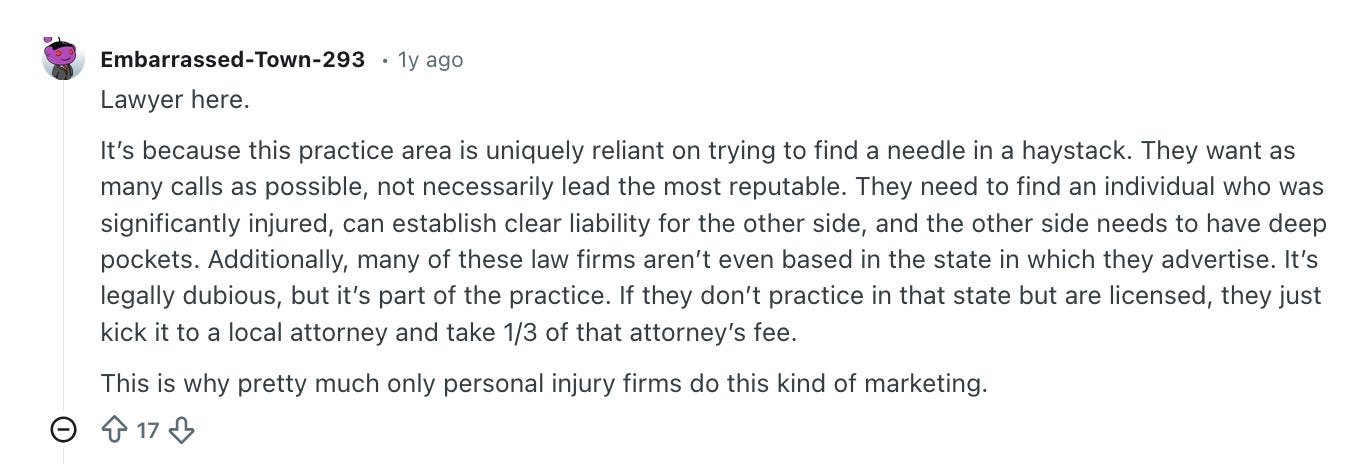
The lawyer isn’t being critical. They’re being honest. But that means the same logic that put 63 personal injury attorney billboards on a single stretch of I-95 in Philadelphia is now being repackaged as an AI optimization strategy.
AI Invisible is not a content, distribution, or platform problem that more marketing can solve.
The way out isn’t optimization.
It’s orientation—specifically, reorienting around the injured person at the moment they need guidance. This brings us to the underlying problem of AI Invisible. This explains why the injured person is in the pre-intake window in the first place, making consequential decisions without anyone qualified in their corner.
The Pre-Intake Problem
A few months ago, a PI attorney said something that has stayed with us:
“All I think about is where our leads are coming from.”
He called his potential clients “leads”—not people, injured people, or clients. Leads. He wasn’t complaining or frustrated. He was just describing his reality the way you describe something you’ve said a thousand times.
He didn’t notice the word he used, and that’s the point.
The fact that it came so naturally told us something important about where the problem lives. It isn’t just at intake. It’s in the orientation that precedes intake.
The pre-intake window is the period of time between the moment someone is injured and the moment they first speak with a personal injury attorney.
It has always existed, and every PI case has one.
For most of the history of personal injury law, it was a place no firm could do anything about—a stretch of time when an injured person was trying to figure out what happened to them, what their rights were, and what to do next, largely without guidance from anyone who had a stake in their outcome.
That window is where an injured person develops their first understanding of their situation, their options, what it may be worth, and who they can rely on.
It’s also where decisions are made that can’t always be taken back. Think of conversations with insurance adjusters, settlement offers considered or accepted, and medical care delayed or pursued based on incomplete information. It’s where the existing personal injury marketing infrastructure has never been present.
The Pre-Intake Problem is an injured person navigating the most consequential legal decision of their life without guidance from an attorney.
The firm that could’ve helped them never knew they existed.
To understand what this looks like in practice, we simulated a pre-intake window experience using the AI platform Claude. We built a detailed Personal Injury Ideal Client Persona and ran a series of conversations to see what an injured person gets when they turn to AI for guidance. The persona we used is Bill.
Bill is 34, lives in South Carolina, and was rear-ended at a stoplight three weeks ago.
He’s dealing with neck and back pain, medical bills, an insurance adjuster who won’t stop calling, and a job that won’t wait for him to heal. He hasn’t called an attorney because he doesn’t know if he needs one. But he has Claude on his phone.
Over three weeks, he had several conversations that would have previously required an attorney.
When the other driver’s insurance called three days after the accident and offered him $3,800 to settle, Bill asked Claude whether he should take it. AI told him not to sign the release, explained exactly why the quick close tactic works against injured people, and outlined what a settlement in his situation should actually include. He almost signed it. AI told him not to and explained in detail what the attorney would have caught in the first consultation.
Two weeks later, Bill had documented damages of over $8,000 and was still in treatment. He asked AI how much his case was worth. He got a breakdown of his economic damages, an explanation of how pain-and-suffering multipliers work in South Carolina, and a direct comparison to the $3,800 offer he had declined. AI calculated it at roughly 45 cents on the dollar for his current economic damages before treatment ended.
The following week, Bill uploaded a photo of his insurance declaration page to Claude and received a coverage analysis explaining the other driver’s policy limits, his own UIM coverage, and why the two together effectively provided him with $75,000 in total coverage. The attorney who could have explained all of this to him still didn’t know he existed.
You can read the full breakdown of Bill and Claude’s simulated conversations here.
In many ways, the AI gave Bill sound responses. But the guidance he received came from a tool with no professional obligation to him, no accountability for the outcome, and no incentive to make sure he found the right attorney.
The gap goes beyond legal representation.
An injured person in the pre-intake window bears the full weight of the disruption caused by the injury.
They have to manage medical appointments, field insurance calls, replace income, gather documentation, and see to ordinary life demands that don’t pause just because something went wrong.
For most of the history of personal injury law, there was no practical way for an attorney to show up for any of that. Now, there is. AI makes it possible to help injured people holistically—with the non-legal dimensions of their situation as much as the legal ones—at the exact moment when that help matters most. That’s a different kind of presence than the PI market has ever offered.
The opportunity to show up in AI is bigger than representation alone, and the AI conversations make that clear.
What’s remarkable about these conversations is what they contain.
An injured person who chats with AI will receive guidance on what a recorded statement to an insurance adjuster means and why they should decline to give one. They’ll get a breakdown of their documented damages (medical bills, lost wages, pain and suffering), organized into a table that functions as a rudimentary case valuation. They’ll learn to read their insurance declaration page and understand what UIM coverage means and why the other driver’s policy limits matter. They’ll be walked through the logic of why a quick settlement offer that arrived in the first week is almost certainly a tactic to close the claim before they understand what it’s worth.
This AI “pre-consultation” happens without an attorney.
By the time that person calls a PI firm, they’ve already formed opinions about their case that will affect every conversation that follows.
The way the personal injury system was built, the injured person is supposed to reach out to a firm, which then evaluates whether the case is worth taking. If it is, the attorney becomes the person guiding them through what comes next. That model assumes the injured person will arrive at intake as a blank slate. They haven’t formed strong opinions about their case, made statements to insurance companies, or accepted guidance from anyone without a proper stake in the outcome.
That assumption no longer holds.
By the time an injured person reaches intake today, they’ve likely had conversations with AI that shaped what they believe their case is worth, what they’re entitled to, and what their next steps should be. Unlike an attorney, AI has no professional obligation to the injured person. It can’t be held accountable by the rules of professional responsibility. If its guidance turns out to be incomplete, inaccurate, or strategically wrong for that person’s situation, there are no consequences for the AI or for anyone else. The injured person simply moves forward with a fixed understanding of their case, and the attorney who takes the case inherits that understanding.
This means injured people are making legally and financially consequential decisions during the pre-intake window, often without realizing the significance of those decisions.
In many cases, those decisions can’t be reversed.
Think of a person who gives a recorded statement before understanding what it means for their case. Or someone who accepts a low settlement offer before they understand their documented damages, because $3,800 feels like a relief. Or a person who decides, after a few AI conversations, that they don’t need an attorney because finding one seems too complicated.
A firm never sees any one of those injured people.
As a mission-driven personal injury attorney, the Pre-Intake Problem cuts to the core of why you became a lawyer in the first place.
You became an attorney to help injured people, but the economics of the contingency-fee structure require firms to make difficult decisions about who they can realistically represent.
Contingency fees give injured people access to legal representation without paying up front. The attorney absorbs the costs and risks and is paid only when they win. That model exists to serve the injured, and it still does. But the acquisition strategies that grew around it (lead generation, intake filtering, volume-based marketing) were designed to find cases that make economic sense, not to meet injured people where they are in the pre-intake window.
The new market rewards something different.
It rewards giving injured people answers, reassurance, and guidance long before they contact a law firm.
An injured person who receives guidance in the pre-intake window arrives at intake better prepared. They better understand their situation, know what their case may be worth and why, and potentially avoid mistakes that erode case value. Economics and impact don’t have to pull in opposite directions.
This lets an injured person trust the process more. And, in turn, trust the attorney who showed up for them when they needed legal counsel most.
The questions to ask yourself: Do you see the pre-intake window as a place to be present? Or will you keep treating everything before intake as someone else’s problem?
The Cost of Inaction
Staying on the current path comes at a cost that shows up differently for the firm, the attorney, and the injured person.
For the firm, the math compounds.
As we mentioned earlier, PI firms convert just 7% of potential clients into consultations—half the industry average of 14%. Sustained year after year, that gap becomes a structural drag that gets harder to close as the forces driving it intensify.
Every dollar invested in supply-side efficiency is a dollar not invested in the pre-intake window where the allocation decision is being made. Every month that passes without a differentiated identity is a month in which AI is learning more about what injured people need and less about what makes any given firm the right answer.
The window for building a meaningful pre-intake presence is not permanently open.
The firms that move now will define what it means to show up for injured people before they’re ready to call anyone. The firms that wait will be trying to enter a conversation that’s already been shaped without them.
For the attorney, the cost is personal.
In law school, you didn’t learn that you’d have to become a rainmaker.
You didn’t learn the economics of running a business that only gets paid when it wins, in a market that rewards whoever spends the most on visibility. You figured it out by doing it. That means you figured it out after you’d already committed to the path.
At some point, the practice you’re running stopped resembling the one you set out to build.
Most attorneys learn to accept that, but few stop to ask why.
The mill of chasing “leads” is a direct contributor. It shows up if you look at your own website and don’t recognize yourself in it. It shows up in the conference rooms where you’re told to upskill and learn AI, and you wonder how it came to this. It shows up in the question that doesn’t get asked often: whether the practice you’re running is still connected to the reason you built it.
The attorneys who feel this most acutely are often the ones who care most.
For the injured person, the cost is concrete.
When no qualified attorney shows up in the pre-intake window, an injured person makes legally and financially consequential decisions on their own.
They have to navigate an important decision without a qualified attorney, without professional accountability, and without anyone whose job it is to ensure they don’t get it wrong. The AI tool filling that space is doing what it’s trained to do. But it has no accountability. It can’t be disciplined by a bar association. It can’t be held responsible when its guidance turns out to be incomplete or wrong. It can’t sit across from an insurance company and argue that this person’s life was meaningfully disrupted and that the offer on the table doesn’t come close to reflecting that.
If nothing changes, the cost is a case that could have been won, but is forfeited in the pre-intake window before any attorney knew it existed. It’s an injured person sitting alone at two in the morning, hurt and confused, asking an AI what to do, and never finding the attorney who would have changed the outcome of their case. It’s someone who needed an attorney in their corner, but got an automated response instead.
But you can choose to be present for an injured person, before they ever think to call.
Pre-Intake AI for Personal Injury
Being present in the pre-intake window is a posture shift.
The attorney goes from waiting for the intake call to joining the conversation earlier.
The firms that understand this see the pre-intake window as a way to help injured people before they make costly mistakes and before confusion turns into bad decisions. These firms recognize that the pre-intake window is not separate from legal representation—it is the beginning of it, and how they can build trust.
In practice, that also leads to more qualified clients, higher-intent engagements, and referrals shaped by credibility established before intake ever begins.
But building a Pre-Intake AI strategy requires three things:
The first is becoming visible and recommended by AI.
AI can only recommend a firm that it can distinguish from every other firm.
That’s why you want to build a specific, differentiated presence that AI can recognize, contextualize, and match to an injured person asking a specific question. You need a genuine point of view that reflects who you are and what you believe about how injured people deserve to be served.
An attorney we work with in South Carolina is a good example of what this looks like. He started with the belief that injured people deserve to have someone in their corner earlier than the traditional PI model ever did. That meant educating clients on their rights before they signed anything, helping them understand what their case involved before they were formally his clients, and showing up in ways most attorneys never thought were their job.
He did it because he believed it was right, not because someone told him it would work.
Over time, that belief became his point of view.
It shows up in the content he creates, the way he talks about his practice, and the way his clients talk about him. This attorney has given a genuine and specific point of view that doesn’t look like every other PI firm’s website. Consider some of the articles his firm has shared:
What to Do After a Motorcycle Accident in SC
How to Find a Wrongful Death Attorney in SC
Workers’ Comp Adjuster Tricks to Watch Out For
He is educating people, not just capturing leads. When AI encounters a firm with that kind of consistent, specific point of view, it has something to work with. When it encounters a firm without one, it doesn’t.
Having a point of view is only the starting point.
Most firms responding to AI right now are bolting a new tactic onto an old stack.
They add a schema plug-in here. An “AI-optimized” blog post there. A vendor pitching “Answer Engine Optimization (AEO)” that turns out to be SEO with a new logo on the invoice.
That fragmented approach is why firms spending six figures a year on marketing still can’t get a straight answer when an injured person asks ChatGPT, “What should I do after a car accident in [their city]?”
The pre-intake window doesn’t reward tactics. It rewards authority that compounds across the AI systems injured people use, like ChatGPT, Gemini, Perplexity, Google AI Mode, Copilot, and Grok. Each of those systems decides who to cite based on different signals, freshness windows, and trust thresholds. No single tactic addresses all of them, but a sequence does.
AI visibility and authority are more than AEO.
AI Visibility looks like an operating system, not a campaign. For example, LawShift’s AI Authority Protocol™ maps and reinforces the signals AI uses to evaluate trust, expertise, and relevance. It establishes your firm’s authority inside AI recommendation environments. These signals are built on how AI actually works: schema, context, entity recognition, topical authority density, and structural signals across your entire digital presence.
It runs against four pillars, in this order:
Category Authority establishes that the firm is a legitimate, recognized entity in personal injury law. It’s not just a website with a phone number. Without this foundation, nothing downstream gets cited.
Vertical Authority layers in practice area depth that make the firm the answer to an injured person’s specific question: motor vehicle, premises, products, wrongful death. Each has its own citation logic.
Risk and Compliance Authority is the pillar most firms overlook, but AI systems weigh it most heavily in legal queries. Injured people ask questions with legal consequences. The models are tuned to only cite verified sources. Firms that haven’t built this signal don’t appear.
Innovation Authority is what separates a firm that gets cited today from one that gets cited in five years. The freshness layer (original commentary, new case patterns, and observed market shifts) tells AI systems this is a living practice, not an archive.
The sequence matters. Skipping a pillar to chase the one that feels easiest is the fragmented-SEO instinct, and it’s exactly why most firms’ AI visibility looks strong on branded queries, like “[Firm name] reviews,” and collapses on the broad queries that drive new business, like “best personal injury attorney near me.”
If you’ve been told you’re “doing AEO” because someone added FAQ schema to your site, you’re not. You’re doing fragmented SEO with a new vocabulary.
The injured people asking AI for help in your market right now are getting answers from somewhere. The question is whether those answers come from a mission-driven firm or from whoever happened to be there first.
An Injured-First strategy means being findable to an injured person before they know your name.
The second is showing up for injured people in the pre-intake window.
Being visible in AI is only half of the equation.
The other half is being useful to the injured person, whether or not they call you. You can now build tools and resources that meet injured people where they are: confused, overwhelmed, and trying to make sense of a situation they’ve never navigated before.
The pre-intake tools that serve those people can be:
An AI-powered chatbot that walks an injured person through the steps to take immediately after an accident: what to photograph, what to save, and what not to say.
A checklist that helps them track lost wages, medical appointments, and out-of-pocket expenses so nothing gets forgotten.
A plain-language guide to their legal rights in specific scenarios, like what they’re entitled to request from the police, what the insurance adjuster can and can’t require of them, and what a recorded statement means for their case.
An insurance policy explainer that turns a declarations page into something a non-lawyer can read and understand.
Eventually, nearly every injured person in the pre-intake window arrives at one of the hardest questions to answer:
“What might my case actually be worth?”
That question—and the lack of trustworthy guidance around it—is why we built CASETIMATOR™.
CASETIMATOR™ allows an injured person to share basic information about the accident, injuries, medical treatment, and the impact of the incident on their daily life. The system then analyzes comparable outcomes drawn from more than 40 years of jury verdict and settlement data to provide a data-informed estimate of the range, along with context on the factors that may influence case value.
But the estimate itself is only part of the function.
The larger purpose is to help injured people better understand the economic and legal reality of what may be happening to them before critical decisions are made. It gives them a framework for thinking about documentation, treatment, insurance communications, lost wages, and the kinds of mistakes that can unintentionally damage a claim early in the process.
None of these tools constitutes legal advice. They provide practical, non-legal information that helps an injured person get organized, feel less alone, and be better prepared for their first conversation with an attorney.
These tools are intentionally designed to reflect how personal injury cases actually work.
The difference between an injured person getting this kind of guidance from a general-purpose AI with no stake in their outcome versus an AI tool purpose-built for plaintiffs is not a small distinction. It has legal, ethical, and practical implications. It’s the clearest expression of what an Injured-First orientation looks like in practice.
The third is the orientation toward Injured-First.
The principle is simple: the injured person is a person, not a lead.
Every tool you build, every piece of content you create, and every conversation you have in the pre-intake window either reflects that, or it doesn’t. It sounds obvious. But look at how the PI market is structured, and you’ll see why it’s harder than it sounds.
A contingency model that only pays when you win
Intake systems built to filter for cases that pencil out
Marketing infrastructure designed to maximize call volume
All of it creates pressure to see the person on the other end of the phone as an opportunity to evaluate, instead of a human being who needs help. Most attorneys inherited that orientation. And most of them have felt the gap between that system and the reason they became a lawyer for as long as they’ve been practicing.
An Injured-First strategy is the competitive advantage.
The dysfunctional incentive in the PI market comes from the lead-generation ecosystem built around attorneys. Lead vendors get paid per lead, regardless of quality or fit. This means their incentive is volume, not outcomes. That structure creates pressure to push as many people through intake as possible, regardless of whether an attorney can genuinely help them. Attorneys end up screening out cases because the people seeking help were never filtered for fit.
Being an Injured-First firm means operating outside that dynamic.
You can show up for injured people in the pre-intake window, before they reach out. You can create tools and content that genuinely help injured people because it’s the right thing to do. You can offer sound guidance and build trust.
Injured people can tell the difference between a firm that’s there for them and a firm that’s there for the case. In time, that difference becomes the practice.
What changes when a firm builds a Pre-Intake AI presence?
For the firm, the conversion math changes.
Moving from a 7% lead-to-consultation conversion rate toward 12% or higher means 70% more pipeline from the same lead volume. That’s not a marginal improvement. That’s a structural shift in how the firm grows.
For the attorney, changes are harder to quantify.
A practice built around a genuine commitment to serving injured people at the moment they need guidance, not just when they’re ready to contact an attorney, is a practice that’s harder to commoditize. It attracts clients who chose you because of what you stand for, not just because you appeared in a search result. It gives back some of the meaning that the old marketing playbook’s economics took away. And it reconnects the daily reality of running a firm to the reason most PI attorneys became lawyers in the first place.
For the injured person, the change is the most straightforward.
They get guidance they can trust from an attorney who has a professional obligation to their outcome at the moment they need it most. They don’t navigate the pre-intake window alone. They don’t make consequential decisions without someone in their corner.
The attorney who shows up for them in that window is the attorney they call.
The Future of Personal Injury Law
If you want your firm to lead the next era of personal injury law, use this moment to ask:
What does the injured person need, and will I be there to provide it?
The attorneys who build their practices around injured people will define the future of personal injury law.
This matters most in the pre-intake window when injured people are trying to understand their situation. They’re deciding whether they have a case worth pursuing and forming their first impressions of who they can trust and who’s on their side.
There are thousands of people navigating the pre-intake window right now—asking AI questions, forming opinions about their cases, and deciding whether to call anyone.
If you show up for them in that moment, you won’t just get more cases. You’ll become the reason this profession still matters in 10 years.
Injured-First. Always.
Lydia and Nick
P.S. – The personal injury market generates $57 billion in annual revenue and accounts for 20% of all legal practices in the country.
We believe that number can grow.
But it requires solving the Pre-Intake Problem and showing up for the injured people who are currently navigating the pre-intake window alone. If you see that window as the most important and most underserved moment in personal injury law, and you want to build an Injured-First practice, we’d love to meet you and talk.
Start by requesting an AI Visibility Audit at LawSHIFT.
Our team will review your AI visibility score, better understand how your firm is currently connecting with injured clients, and identify opportunities to strengthen your presence during the pre-intake window—before trust, decisions, and referrals are shaped without you.
About LawSHIFT
LawSHIFT is the Pre-Intake AI company for personal injury law. We created the AI for PI Index™—the legal industry’s first benchmarking system that measures how AI platforms evaluate, surface, and recommend personal injury law firms.
Founded in 2013 and headquartered in New York, LawSHIFT brings together more than 50 years of combined experience across personal injury marketing, legal technology, legal category design, and growth strategy. We’ve helped drive more than $400 million in outcomes for law firms and billions in revenue for legal technology companies.
We were built around a question few in the industry ask: What happens before an injured person ever calls an attorney?
We named that challenge the Pre-Intake Problem™—the period when injured people are trying to understand what happened, what their rights may be, what their case could be worth, and what to do next, often before ever speaking with legal counsel.
That insight became the foundation for a new category: Pre-Intake AI for PI™.
Today, injured people increasingly turn to AI before contacting a law firm. They ask questions, seek guidance, evaluate their options, and begin deciding who they believe can help them long before intake ever begins.
LawShift builds the AI systems, visibility infrastructure, and pre-intake tools designed for that window.
Our growing suite of Pre-Intake AI tools includes CASETIMATOR™, a data-driven case valuation and guidance platform that helps injured people better understand their situation in under three minutes. We also help personal injury law firms strengthen how they are understood, evaluated, and recommended by AI systems through our proprietary AI Authority Protocol™.
Our mission is to help injured people find trusted legal counsel when they need it most.
LawSHIFT is Injured-First.
About Nick Kringas
Nick Kringas is the Founder and CEO of LawSHIFT. For 15 years, he built SEO visibility for personal injury law firms and generated over $400 million in client outcomes. When AI began reshaping how injured people find counsel, he partnered with Lydia Flocchini to solve the problem his own data revealed: law firms heavy on SEO have near-zero AI visibility.
Together, they’re helping personal injury attorneys survive and win as the market landscape shifts.
About Lydia Flocchini
Lydia Flocchini is the Legal Category Designer and partner at LawSHIFT. A lawyer by training, she made an early bet that legal technology—not legal practice—was where she could transform how lawyers work. For three decades, she’s helped bring some of legal tech’s most important categories to market: legal research at Thomson Reuters, legal analytics at Lex Machina, and others.
Now, with Nick Kringas, she’s solving the Pre-intake Problem to help law firms show up for injured people when AI is reshaping how clients find trusted counsel.
The Legal Pirates
Most people build careers, but very few find their business bandmate.
Nick and Lydia did both. They met inside the Category Design Academy and recognized something in each other: a shared language, shared experience, and shared conviction about what the legal industry actually needs.
As legal category designers, they reject the premise of what everyone else believes about personal injury law. They believe that the attorneys who define the future aren’t the ones competing inside existing markets—they’re the ones bold enough to build new categories around problems nobody else has properly named yet and Injured-First.
They’re also the hosts of the Legal Pirates podcast, where they jam on category design for the legal industry—sharing frameworks and real-time thinking about how legal professionals can escape the sea of sameness.
To learn more, visit LawSHIFT.ai
If you would like others to learn about the Pre-Intake Problem, please share this mini-book or leave a comment to let us know what you thought.
I'm so excited to see our manifesto go live and to share the problem we've been obsessed with solving - The Pre-Intake Problem in personal injury, the period between injury and intake when the injured need legal counsel most. This is the biggest problem facing personal injury today.
It's amazing to see the mini-book live! We have been on this journey for over a year. Thinking deeply about what happens in the black hole before the injured seeks legal counsel. I am excited to share our learnings, research, and insights as we solve the Pre-Intake Problem.